Transcript
Announcer:
You’re listening to VacciNation on ReachMD, and this episode is sponsored by CSL Seqirus. Here’s your host, Dr. Jennifer Caudle.
Dr. Caudle:
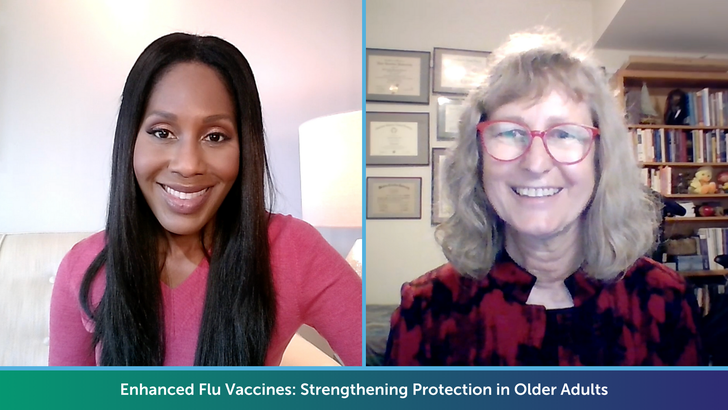
Welcome to VacciNation on ReachMD, I'm your host, Dr. Jennifer Caudle, and joining me to discuss the use of enhanced influenza vaccines in adults 65 years and older is Dr. Irene Hamrick. She's a Professor of Geriatrics at the University of Cincinnati College of Medicine and a Certified Medical Director through the American Board of Post-Acute and Long-Term Care Medicine. Dr. Hamrick, thanks so much for being here today.
Dr. Hamrick:
Thank you for having me.
Dr. Caudle:
Of course. So let's start with some background. Why are older adults at greater risk for influenza-related complications, and what do we know about the effectiveness of standard dose vaccines in this population?
Dr. Hamrick:
So immunity decreases over time. Different types of immunities decrease at a higher rate than others, but older adults are at a disadvantage when they have to mount an immune response to vaccines, but also for viruses in general. That's why older adults oftentimes have worse outcomes with infections, and that's why the vaccines oftentimes are not as effective. So we have used, in the recent past, high-dose vaccines for people over 65 and adjuvanted vaccines.
Dr. Caudle:
Thank you. And given that context, how might these advanced vaccines reduce flu-related hospitalization, complications, and even mortality in adults over 65?
Dr. Hamrick:
Yeah, they do reduce infection to a small degree, but most of all, the immunity is in the IgG, which is a longer-acting immune globulin that circulates in the blood. The IgA is in our mucous membranes and keeps us from getting infected. But that only hangs around—when I teach my learners, I always say it's like Lent—it hangs around about six weeks or 40 days. So the IgA is what keeps us from getting infected, because it covers our mucosa and our airway, but the IgG in our blood hangs around for years, and it then gets activated when we have an infection and when we get sick, and that's how it decreases hospitalization. Even though we get sick, we don't get nearly as sick if we have the vaccine on board.
Dr. Caudle:
For those of you who are just tuning in, this is VacciNation on ReachMD. I'm your host, Dr. Jennifer Caudle, and I'm speaking with Dr. Irene Hamrick about improving flu protection in older adults.
So Dr. Hamrick, it's clear from our conversation so far that enhanced vaccines play an important role in protecting aging populations. But from your perspective, what are the most common barriers that keep older adults from getting vaccinated, and how can we address them?
Dr. Hamrick:
Well, many patients don't think that they're going to get sick. Some of them don't get out a lot, but even if you go to the grocery store, you can catch it. Of course, you have grandchildren or great-grandchildren coming over, and they're just a plethora of viruses when they get sick. So they're very generous in sharing. So I encourage all my patients to get the flu vaccine.
Some patients are afraid of getting the flu from the flu vaccine. And they say, “Well, I used to get it from the flu vaccine, and I just don't want another one.” And I will always ask, “How long ago was that?” If it was 30 or 40 years ago, at that time we actually had live attenuated virus—live viruses—and people could get sick, but it’s an attenuated virus, so it's not as potent as a regular flu virus. But the newer ones cannot make you sick.
Now, people get symptomatic from the vaccine, particularly if it really works well, because our immune response is what gives us those symptoms. That's why we get so sick from the flu, because our immune system kicks in and it makes us run a fever and have chills and sweats, and we can't sleep well. So those are all symptoms of the immune system, not of the virus itself. So most patients then agree with that, that they would take the flu vaccine.
The other hurdle I oftentimes see is that patients cannot get out effectively. And if they have to go to their eye doctor, the eye doctor does not have the flu vaccine, which is unfortunate. But then they should just stop by their primary care doctor, the health department, Walgreens, or wherever. It's now so widely available everywhere that it should be fairly easy for our older adults to just stop in someplace and get it.
Dr. Caudle:
More specifically, what communication strategies can we use to present these vaccine options to patients without causing confusion or concern?
Dr. Hamrick:
Yeah, so just stating that these flu vaccines have been around for many years and have been well proven to be effective and not to have severe side effects. Then another argument I have is that when you develop the flu infection, influenza, it actually increases your risk of developing dementia down the road. And most of my older adults are more afraid of developing dementia and becoming dependent on their loved ones than of dying. So that is oftentimes an argument that really carries a lot of weight.
Dr. Caudle:
Before we close out our program, Dr. Hamrick, do you have any final insights on how we can optimize influenza vaccine uptake among older adults?
Dr. Hamrick:
Yeah, I found the most important question to ask is about dementia. How afraid are you of developing dementia and becoming dependent on your family? And viral infections, particularly influenza, increase your risk of stroke and heart attack, but also dementia down the road.
And then also talking about their grandchildren—to protect your grandchildren from getting infected, especially if they're infants. They really don't have an immunity yet. By getting vaccinated, you reduce your risk of getting infected, but also reduce your risk of viral shedding if you do get infected before you become symptomatic with the viral illness.
Dr. Caudle:
Well, those are really great comments for us to think on as we come to the end of today's program. I'd like to thank my guest, Dr. Irene Hamrick, for joining me to discuss the role of enhanced flu vaccines in protecting older patients. Dr. Hamrick, it was great having you on the program today.
Dr. Hamrick:
Thank you.
Announcer:
This episode of VacciNation was sponsored by CSL Seqirus. To access this and other episodes in our series, visit VacciNation on ReachMD.com, where you can Be Part of the Knowledge. Thanks for listening!